

Introduction to the Canada Region
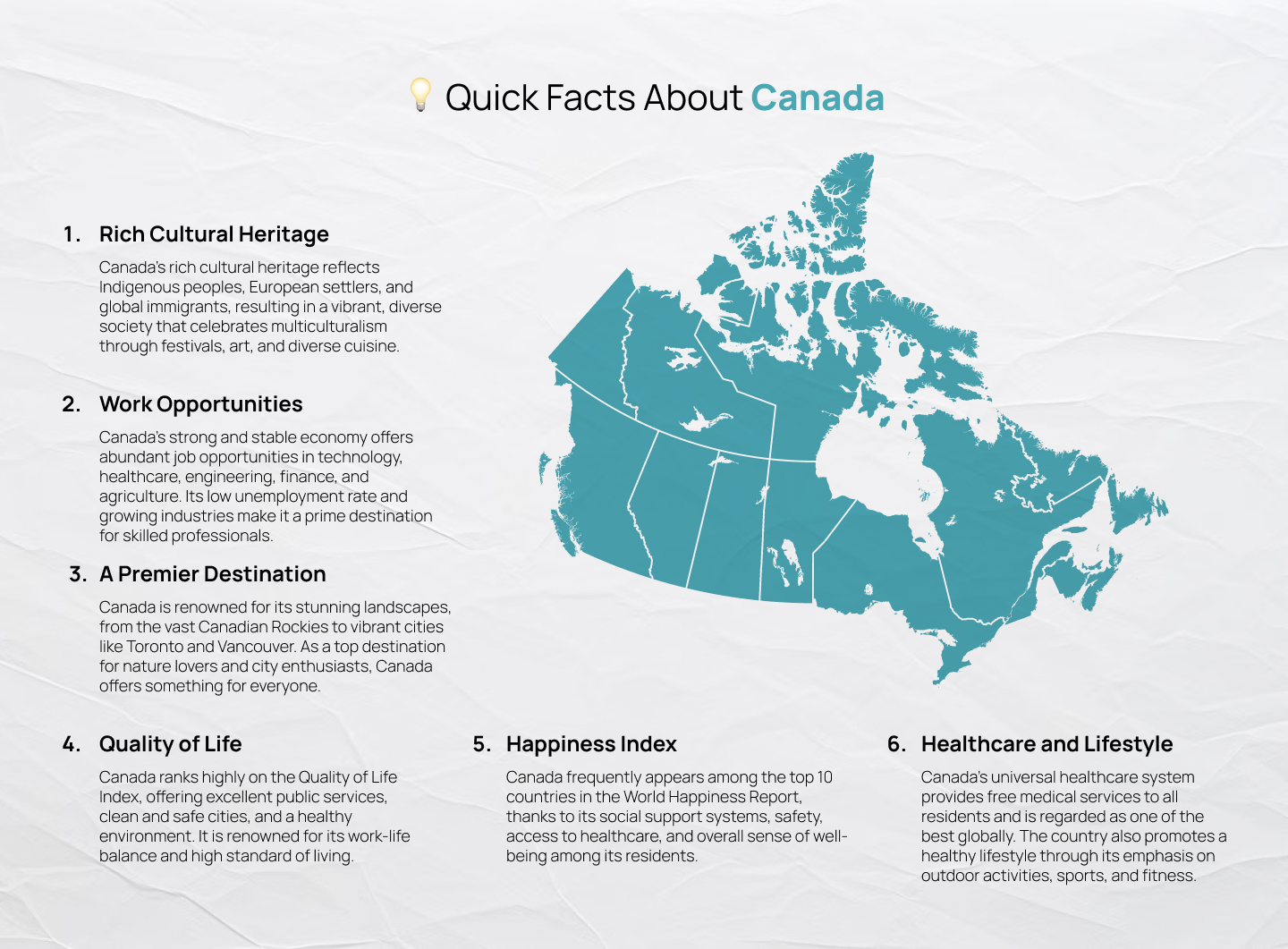
Canada, the second-largest country in the world, is known for its stunning natural landscapes, inclusive society, and high quality of life. From the vibrant urban hubs of Toronto, Vancouver, and Montreal to the scenic beauty of the Rocky Mountains and Niagara Falls, Canada offers a perfect blend of urban sophistication and outdoor adventure. With its strong economy, excellent healthcare system, and world-class education, Canada has become one of the most sought-after destinations for individuals looking to build a prosperous life through permanent residency.
Why Permanent Residency in Canada?
Canada is consistently ranked among the top countries for quality of life and immigration due to its welcoming immigration policies and numerous benefits for permanent residents. Here’s why Canada is an excellent choice for obtaining permanent residency:
- Pathway to Citizenship: Obtaining Permanent Residency (PR) in Canada is one of the most straightforward routes to becoming a Canadian citizen, offering long-term security for you and your family.
- Access to Universal Healthcare: Permanent residents in Canada have access to Canada’s universal healthcare system, which provides world-class medical services free of cost.
- Educational Benefits: Permanent residents enjoy access to high-quality education, with free public schooling for children and significantly lower tuition fees for higher education compared to international students.
- Work Opportunities: Canada’s booming economy provides permanent residents with full employment rights, allowing you to work anywhere in the country and pursue the career of your choice.
- Social Benefits: Canadian permanent residents are eligible for a wide range of social benefits, including pension plans, child benefits, and unemployment insurance.
- Multicultural Society: Canada is renowned for its multiculturalism and respect for diversity, ensuring a welcoming environment for people from all backgrounds.
Get In Touch
As a permanent resident, you and your dependants have:
- The Right to receive most social benefits that Canadian citizens receive, including health care coverage.
- The Right to live, work or study anywhere in Canada.
- The Right to apply for Canadian citizenship after a period of residence.
- Protection under Canadian law and the Canadian Charter of Rights and Freedoms. As a permanent resident, you also must pay taxes, and respect all Canadian laws at the federal, provincial and municipal levels.
The Canada PR Process: How Do I Become a Permanent Resident of Canada?
There are a number of ways to obtain a Canadian PR. You should think about it in terms of “immigration categories”. Each category represents a legal means to obtain permanent resident status. Five main categories for Canadian Permanent Residence are:
- Express Entry Category
- Business Immigration
- Family Class Immigration
- Canadian Experience Class
- Provincial Nominee Programs
Labour Market Impact Assessment (LMIA)
A Labour Market Impact Assessment (LMIA) is a document that an employer in Canada may need to get before hiring a foreign worker.
A positive report on LMIA will show that there is a need for a foreign worker to fill the job. It will also show that no Canadian worker is available to do the job. A positive LMIA is sometimes called a confirmation letter.
If the employer needs an LMIA, they must apply for one and once an employer gets the LMIA, the worker can apply for a work permit.
To apply for a work permit, a worker needs:
- a job offer letter,
- a contract,
- a copy of the LMIA, and
- the LMIA number.
Provincial nomination programs (PNPs)
offer a valuable way to Canadian permanent residence. The Canadian provinces and territories nominate individuals to immigrate to Canada and who are interested in settling in a particular province. Each Canadian province and territory (except Nunavut and Quebec) has its norms that dictate Provincial Nominee Program. Each PNP has at least one immigration process that is aligned with the federal Express Entry immigration selection system. Provincial nominations issued under these Express Entry-aligned streams are known as ‘enhanced nominations’ and award Express Entry candidates an additional 600 Comprehensive Ranking System (CRS) points.
How the Provincial Nominee Program (PNP) works?
This program is for workers who:
- have the skills, education and work experience to contribute to the economy of a specific province or territory
- want to live in that province, and
- want to become permanent residents of Canada Each province and territory has its own “streams” (immigration programs that target certain groups) and requirements. For example, in a program stream, provinces and territories may target:
- students
- business people,
- skilled workers
- semi-skilled workers
FAQ for Permanent Residency in Canada
There are several pathways to apply for permanent residency, including the Express Entry system, Provincial Nominee Programs (PNPs), and family sponsorship. The Express Entry system is one of the fastest ways, assessing applicants based on their skills, work experience, and language proficiency.
The processing time for permanent residency applications varies based on the immigration pathway you choose. For the Express Entry system, it typically takes 6 to 12 months. Provincial Nominee Programs may take longer depending on the specific province’s requirements.
Yes, permanent residents have the freedom to live and work in any province or territory in Canada, with full employment rights similar to Canadian citizens.
Yes, permanent residents have access to Canada’s universal healthcare system, which covers essential medical services and hospital care free of charge. However, the exact coverage and benefits vary slightly by province.
Permanent residents enjoy a wide range of benefits, including access to healthcare, the right to live and work anywhere in Canada, social benefits (such as pensions and unemployment insurance), free public education for children, and the ability to apply for Canadian citizenship after a few years of residency.
As a permanent resident, you can live outside Canada, but you must be physically present in Canada for at least 730 days (2 years) in every 5-year period to maintain your PR status.